Exploring Therasia and the Santa Irini Retreat: Perhaps the Best of Slow Travel in Greece
Travel for me has changes as I've moved through life. At first, I was drawn to the “I’ve been there” list of the world’s most famous destinations: London, Paris, Madrid, Sydney, and New York City. Later, my interests became more personal as I sought outdestinations that allowed me to indulge my interests from nature and adventure, tropical getaways and destinations with wine centric experiences.

Then there comes a point when we care less about what is popular to others and especially the million-plus follower influencers and their “look at me here” posts. I began to look for somewhere more real, to slow down a bit where there was nowhere to hurry to. A place that felt more real and where my valuable holiday time felt well spent. And that’s just what I found in a place that most have probably never heard of.
Just a short boat ride from one of Greece’s most famous and, yes, most popular islands, Santorini, Therasia feels like a different world. Often described as Greece as it was fifty years ago, it remains a small island where you'll find broken English, if that, from the locals. Greek is the language of daily life, where communities are close-knit, and where life is literally grounded in agriculture, fishing, and the sea. It is a rare place, refreshingly unspoiled by mass tourism.

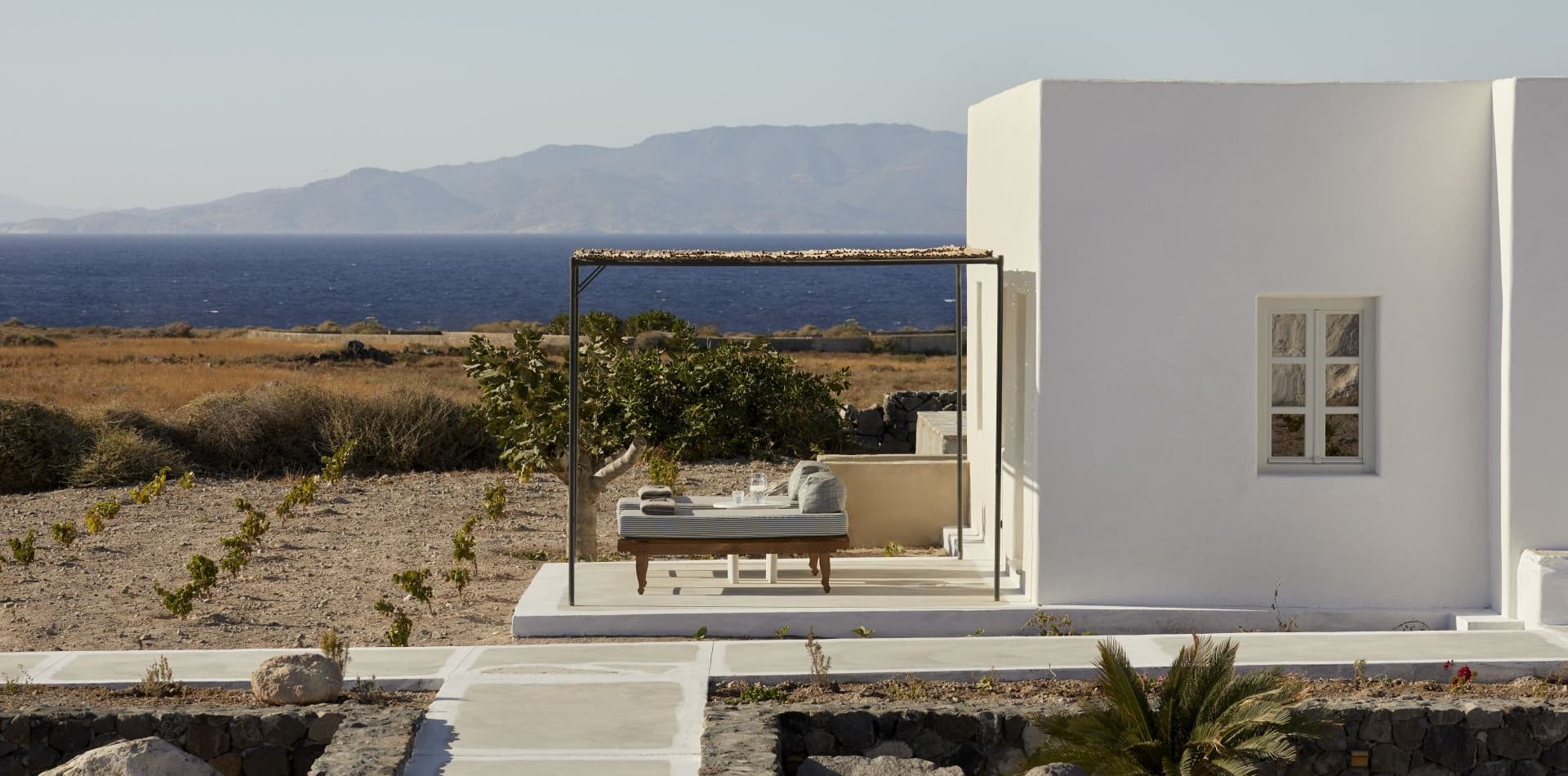
Santa Irini Retreat sits within this setting. Built around the Church of Agia Irini and facing directly across the caldera toward Santorini, it reflects the soul of island. The focus is on respect for what already exists, the landscape, the history, and the pace of life, while offering a quieter form of elevated accommodation and a slower style of holiday for enlightened travellers who are looking beyond for something beyond the obvious.
The Island of Therasia Greece and Its Place in the Santorini Caldera
Therasia is part of the same volcanic caldera as Santorini but receives only a minuscule fraction of the visitors. With a permanent population of less than two hundred residents and two main villages, it offers a side of the Cyclades that few travellers experience. The Minoan eruption around 1600 BCE split the original island of Strongili into the modern fragments, leaving Therasia inhabited but increasingly isolated as its population departed for opportunity elsewhere.

Where Santorini is busy and crowded, Therasia remains quiet and rooted in tradition. Tourism exists on a small scale. The landscape is marked by steep cliffs, dry stone terraces, agricultural plots, and traditional cave homes carved directly into the rock.
Santa Irini Retreat Therasia Hospitality and Philosophy
Named after Saint Irini, from whom Santorini itself derives its name, Santa Irini Retreat embodies the island's character. It is not a large resort built around extensive amenities, but rather a deeply personal retreat centred on place, people, and authentic atmosphere. Created by Dimitris Kriezis and Pâris Savvidis, who departed corporate careers in Athens to build a different life on Therasia, the property reflects their vision of slow living, local gastronomy, sustainability, and genuine connection to the island. Guests are welcomed personally by the owners rather than through a formal reception experience. That sense of personal hospitality defines the stay from beginning to end.
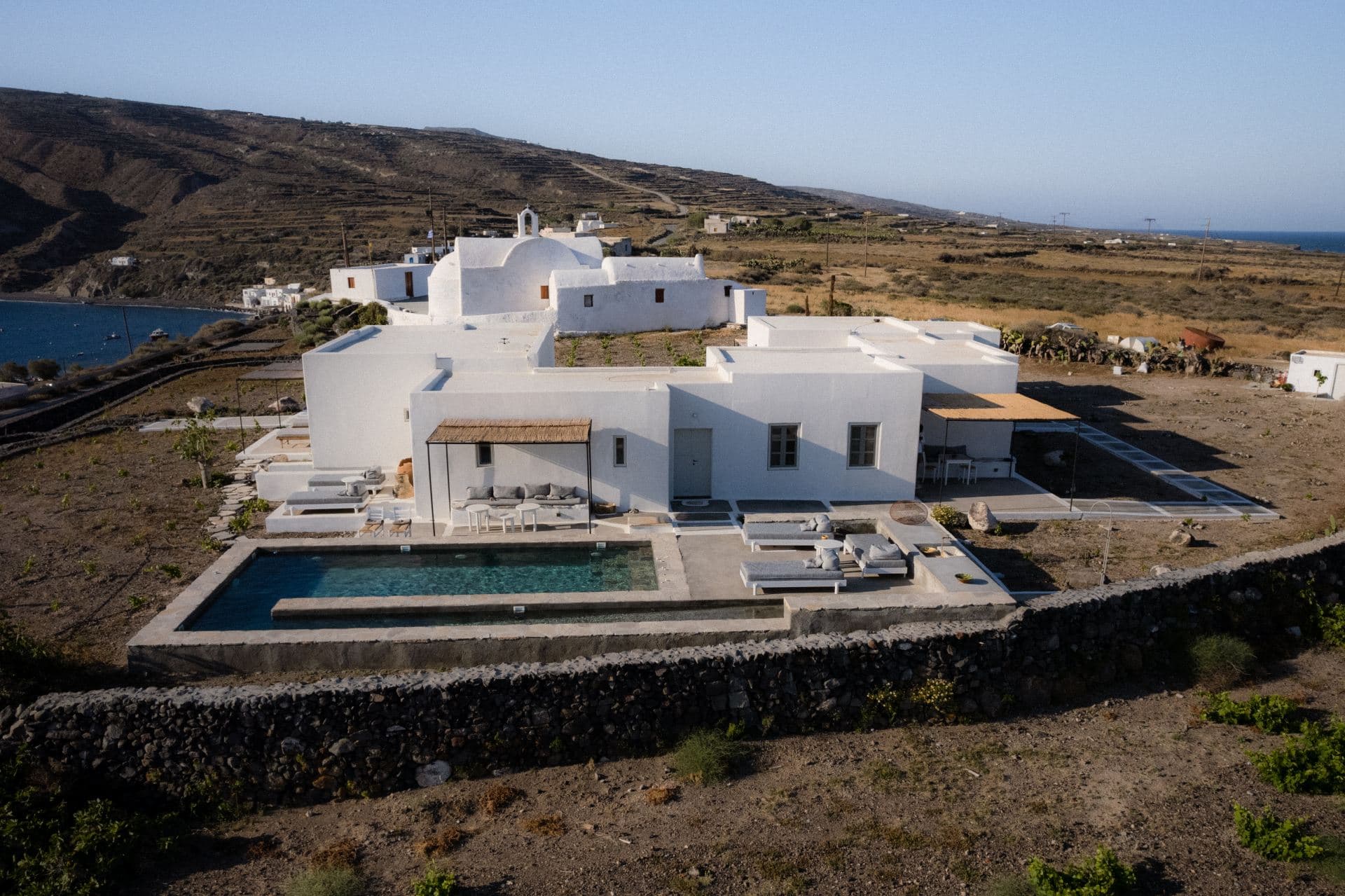
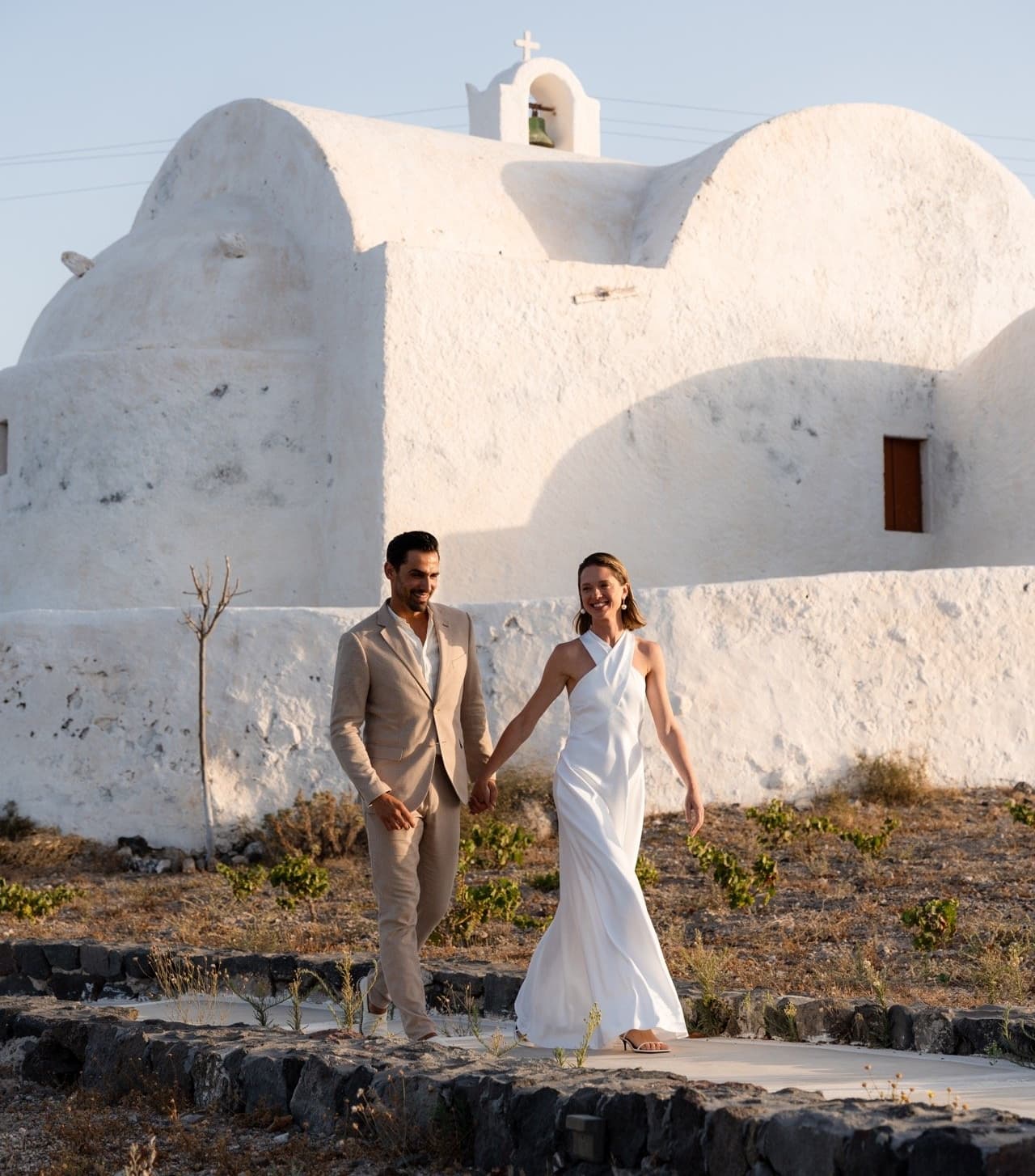
The retreat's story is closely tied to the history of the island itself. Nearby stands the small chapel dedicated to Saint Irini, completed in 1867. Like many churches across Greece, it is modest in scale rather than grand, featuring traditional iconography and serving as an important gathering place for the local community.

The historic church and surrounding land was inherited by Dimitrios which he continues to preserve with care. That history forms part of the retreat's identity and contributes to the strong sense of continuity between the property and the community.

Each year on May 5, the feast of Agia Irini gathers residents of Thirassia and visitors from across the caldera, including Santorini. Food is prepared communally in large pots over open fire, a practice rooted in long tradition. This celebration embodies the relationship between land, faith, and family stewardship that defines Santa Irini Retreat and ties it inseparably to the community that surrounds it.
Santa Irini Retreat Architecture Design and Caldera Setting
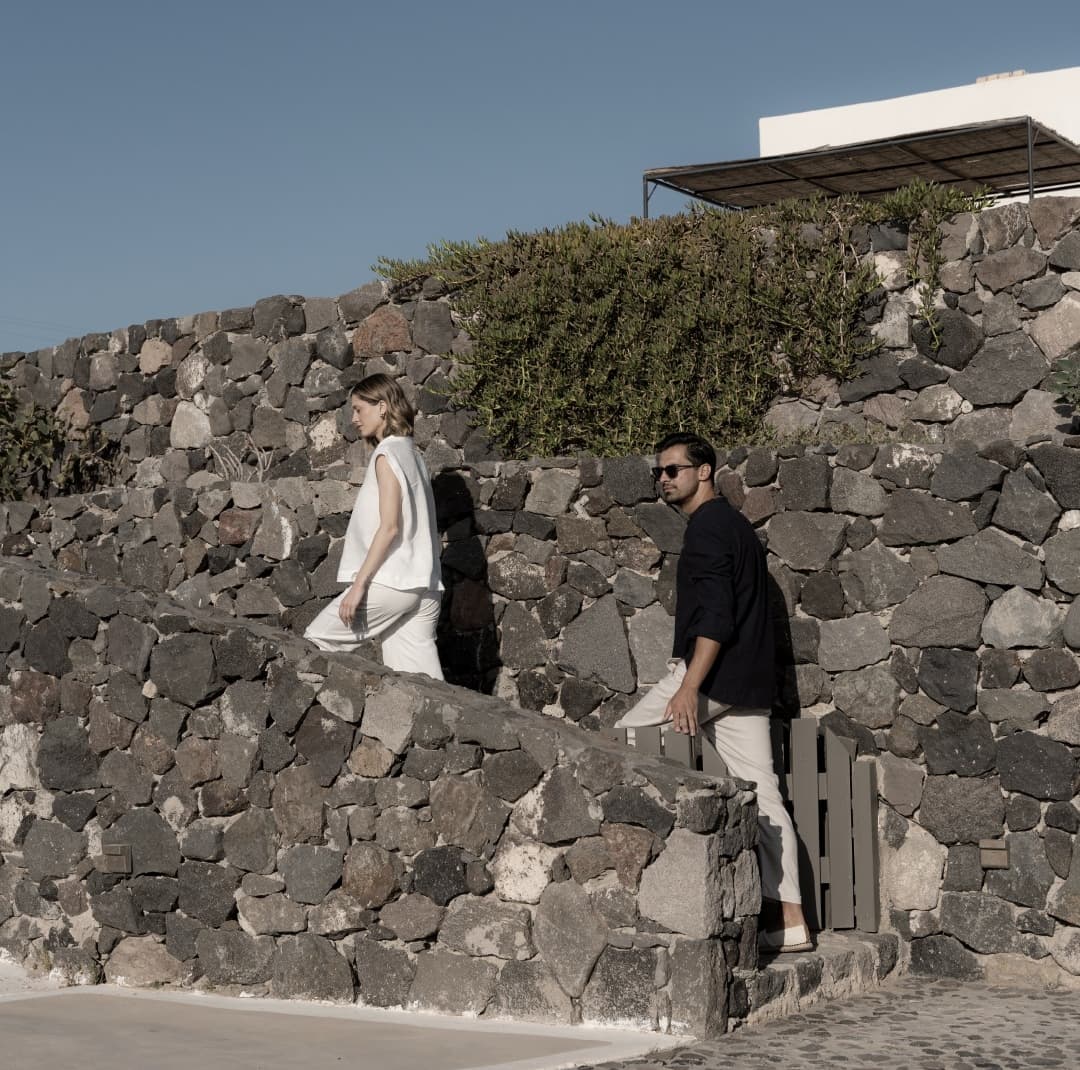
The architecture is built into the landscape. Using local stone and traditional Cycladic forms, the retreat . follows a U-shaped, or Pi-shaped (Π), configuration designed to shelter from the meltemia, the intense northeastern winds of summer, while maintaining full exposure to the caldera views.

Interiors combine natural materials, earthy colours, and minimalist design. Modern amenities are present but don't overwhelm the property's character. Antique furniture from the chapel and Athens flea markets sits alongside contemporary pieces: wicker baskets, embroidered tapestries, church candelabras, vintage olive oil tins, brass mortars and pestles, and paint-worn wooden pieces.

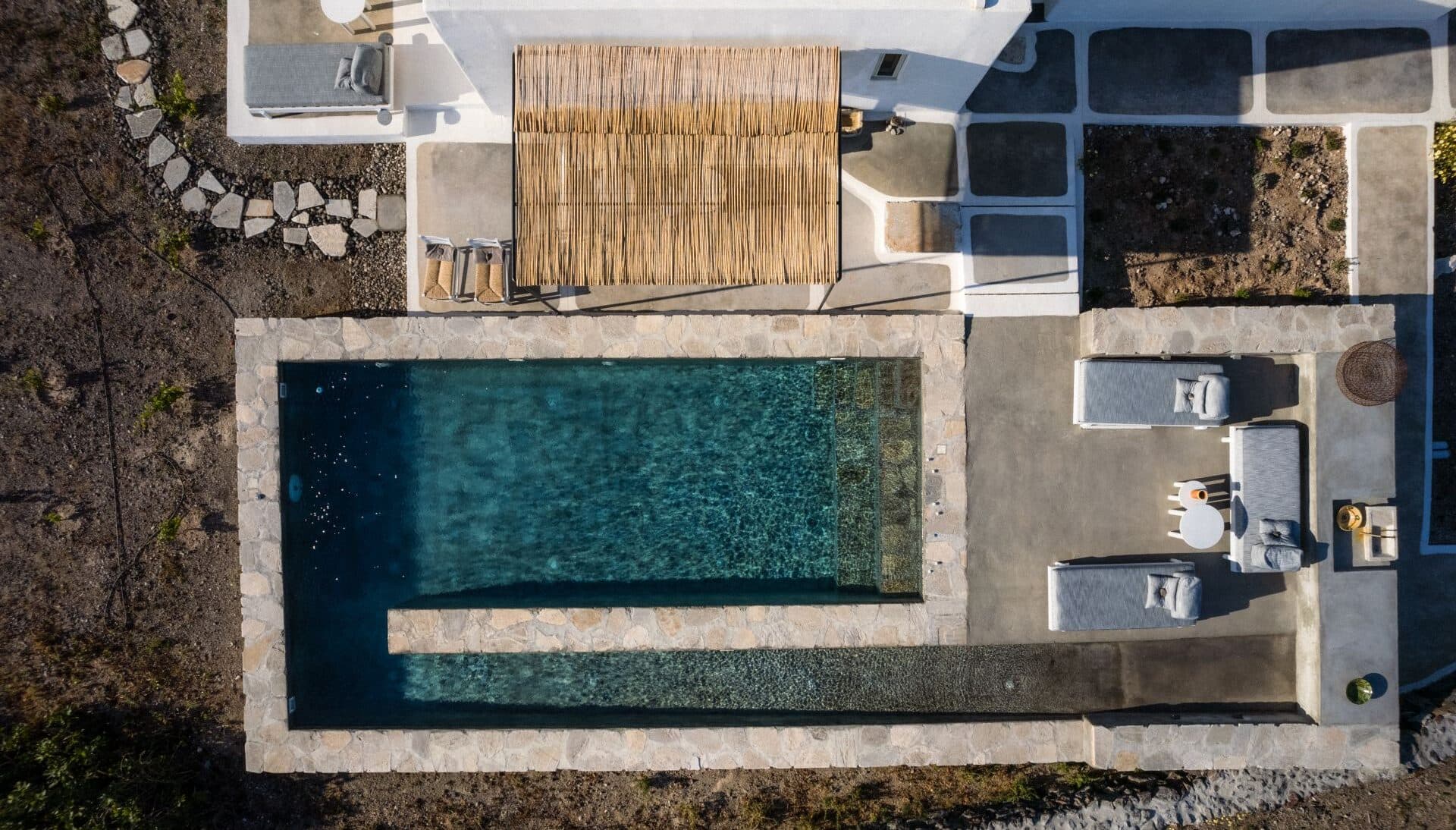
A communal outdoor lounge serves as a gathering place. Long tables encourage conversation, with multiple seating areas offering views. The pool, lined with black volcanic stone and overlooking the caldera, offers uninterrupted views toward Santorini. The water appears an improbable blue against the dark stone. Light shifts across the water throughout the day. There is a wheelchair-accessible jacuzzi in the back.
Accommodation at Santa Irini Retreat Therasia Suites
The physical spaces where you stay at Santa Irini are inseparable from the experience of being on Therasia itself. There are four suites, three of which are named Margarita, Avgi, and Theodosia, honoring women who inspired the founding family.

Santa Irini is ideal for a group, a multi-generational trip where grandparents, siblings, and children can gather together. It works equally well for a small wedding, where the couple and their closest family can celebrate without the formality of a hotel event. It is suited for a business retreat, a place where a small team can step away from the noise and actually think. For two people on a romantic holiday, it offers intimacy with views of the church and caldera, a space designed for the kind of slowness that deepens connection. For long-stay solo travellers, it provides solitude without isolation; you are part of the property's daily rhythm while maintaining complete privacy. The retreat adapts to how you want to experience it.

The suites are spacious and individually designed. Whitewashed stone walls are the backdrop. Antique furniture sourced from the chapel and Athens flea markets sits simply: wicker baskets, embroidered textiles from local artisans, wooden pieces worn smooth by time. Period photographs of the island hang on walls, documenting how people lived here. Nothing is curated for effect; items are present because they belong.

Textiles throughout are sourced locally. Embroidered tapestries hang in entry spaces. Bed linens are plain and substantial. Throws are woven in patterns that echo traditional island designs. Everything is meant to be used, lived with, worn into familiarity. Bathrooms feature natural stone surfaces incorporating local volcanic rock. Rainfall showers provide ample pressure and comfort. Everything feels elemental rather than decorated.

Each suite opens directly onto a private terrace, blurring interior and exterior. High ceilings and careful orientation provide natural cooling; thick stone walls regulate temperature without reliance on air conditioning. Natural light is abundant, and views extend across the caldera or surrounding landscape.
The Nikos Heritage Suite: The Priest's House

One suite at Santa Irini holds particular distinction. The Nikos Heritage Suite occupies what was once the priest's house, positioned directly within the inner courtyard of the heritage church. The location itself is the experience.

The suite is spacious, with generous internal living space and a substantial private outdoor area, and accommodates three guests. From every vantage point, the room commands 360-degree views: the sea, the sunset directly over the caldera, and the caldera itself.

The bathroom is perhaps the most distinctive feature. A vaulted stone ceiling arches overhead, and the walls are raw concrete with a textured finish that feels more like a cave sanctuary than a conventional bathroom. A hand-carved stone basin sits as the centerpiece, with natural light filtering through shuttered windows, and hooks carved directly into the walls. Everything is stripped back to essentials: stone, light, water, just as it was a century and a half ago.
In total, Santa Irini Retreat accommodates up to 18 guests across four individually designed suites and two additional Heritage Rooms located on a lower level, each with a private entrance and en-suite bathroom. The entire property may also be reserved exclusively for one group.
Santa Irini Retreat Dining Experience Local Food of Therasia
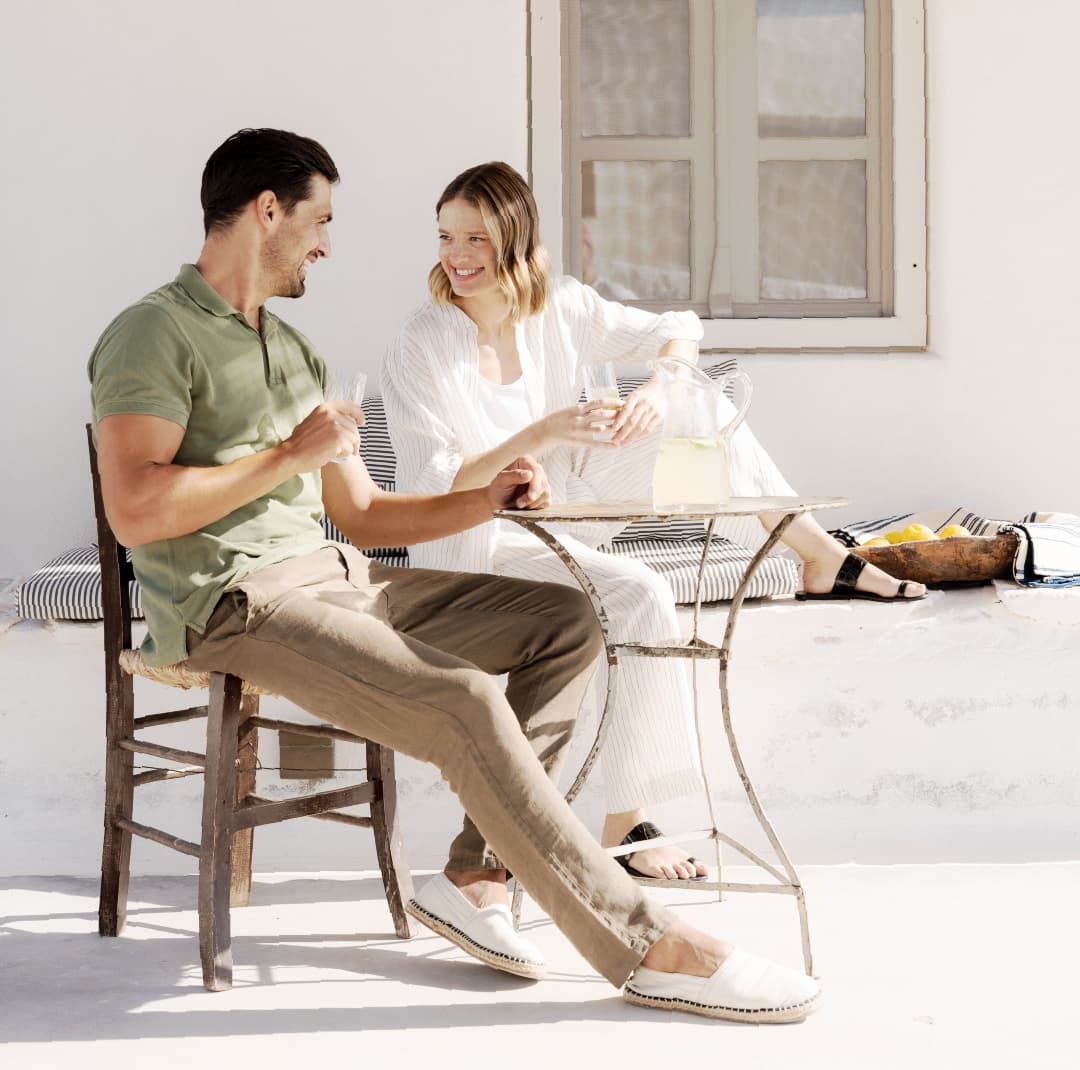
Food is central to the Santa Irini experience. Breakfasts feature fresh bread from the island's baker, local cheeses, eggs from a small holding, seasonal fruit, homemade jams, and honey from a beekeeper who maintains hives at the abandoned village. The feta tastes of the particular milk of the goats that produced it.

Dinner reflects the food of the island itself. Recipes are rooted in Cycladic home cooking and rely on local ingredients. Fresh seafood takes centre stage alongside lamb, vegetables, herbs, and olive oil. The chef cooks the exact same dishes for guests that she prepares for her own family. This goes far beyond what hotels typically call "home cooking."

Meals are served communally from a long table in the kitchen or on the terrace adjacent to the church, surrounded by vines. Regional wines accompany the meals. Cooking classes are available, emphasizing traditional techniques and the importance of seasonality.
Exploring Therasia Greece Villages and Agrilia Cave Village 
Guests may explore the island by rental car or scooter as well as by guided tours. The abandoned cave village of Agrilia provides one of the island's most significant excursions. Once inhabited by farmers and seafarers, the dwellings were carved directly into volcanic rock.

At its peak, the village housed up to 700 residents who cultivated barley, fava beans, and Santorini tomatoes. The yposkafa, traditional cave houses, reveal how generations adapted to life on a remote island.

The Church of the Virgin Mary, Panagia Lagadi, built in 1887, stands at the entrance to the settlement, marking the threshold into the village. It is modest and whitewashed, with simple Cycladic proportions and weathered stone detailing that blends into the volcanic landscape rather than standing apart from it.

Similar cave architecture is found throughout Therasia, demonstrating the practical relationship between local communities and the volcanic environment. The villages themselves are equally worth exploring, with traditional houses, local cafés, and family-run tavernas offering a chance to slower and chat with friendly locals. Many speak limited English, if at all, but the warmth of their smiles and expressions needs no translation.

Best Restaurants in Therasia Greece Including Panorama Resto
Exploring the island inevitably leads into its food, not as a separate experience but as an extension of place itself. The same conditions that shape the landscape, sea, soil, and season, also determine what appears on the table.

The island’s tavernas serve both residents and visitors, their menus shaped by what has been caught or harvested that day. Seafood dominates, alongside vegetables grown in small plots and recipes passed through families rather than formal menus. It is not unusual for an owner to say plainly if something is unavailable or not worth serving that day, a candour that feels tied to the rhythms of supply rather than service.

Dining often takes place beside the sea or along simple waterfronts, where the setting is as immediate as the food itself. The cooking is restrained, focused on clarity of flavour rather than interpretation, and it becomes part of how the island reveals itself.

A particular highlight is Panorama Resto, a family-run restaurant led by George Syrigos, now in its second generation. Set above the caldera with views stretching toward Korfos, it serves contemporary gourmet Greek dishes that remain rooted in local produce: sardine bruschetta with asparagus and egg cream, handmade linguine with shrimp and mussels, and seabream fillet paired with fava and cuttlefish ink. The food is precise but unforced, shaped by what the island provides rather than what a menu demands.
Sailing the Santorini Caldera from Therasia Traditional Boat Experiences

Experiencing Therasia from the water is essential. Traditional fishing boats called kaiki, operated by local families, are adapted for leisure cruising while retaining authentic character. The cruise circles the volcanic landscape, revealing dramatic cliffs, hidden coves, and rock formations that define the Santorini caldera. Routes often include views toward the volcanic islets of Nea Kameni and Palea Kameni.

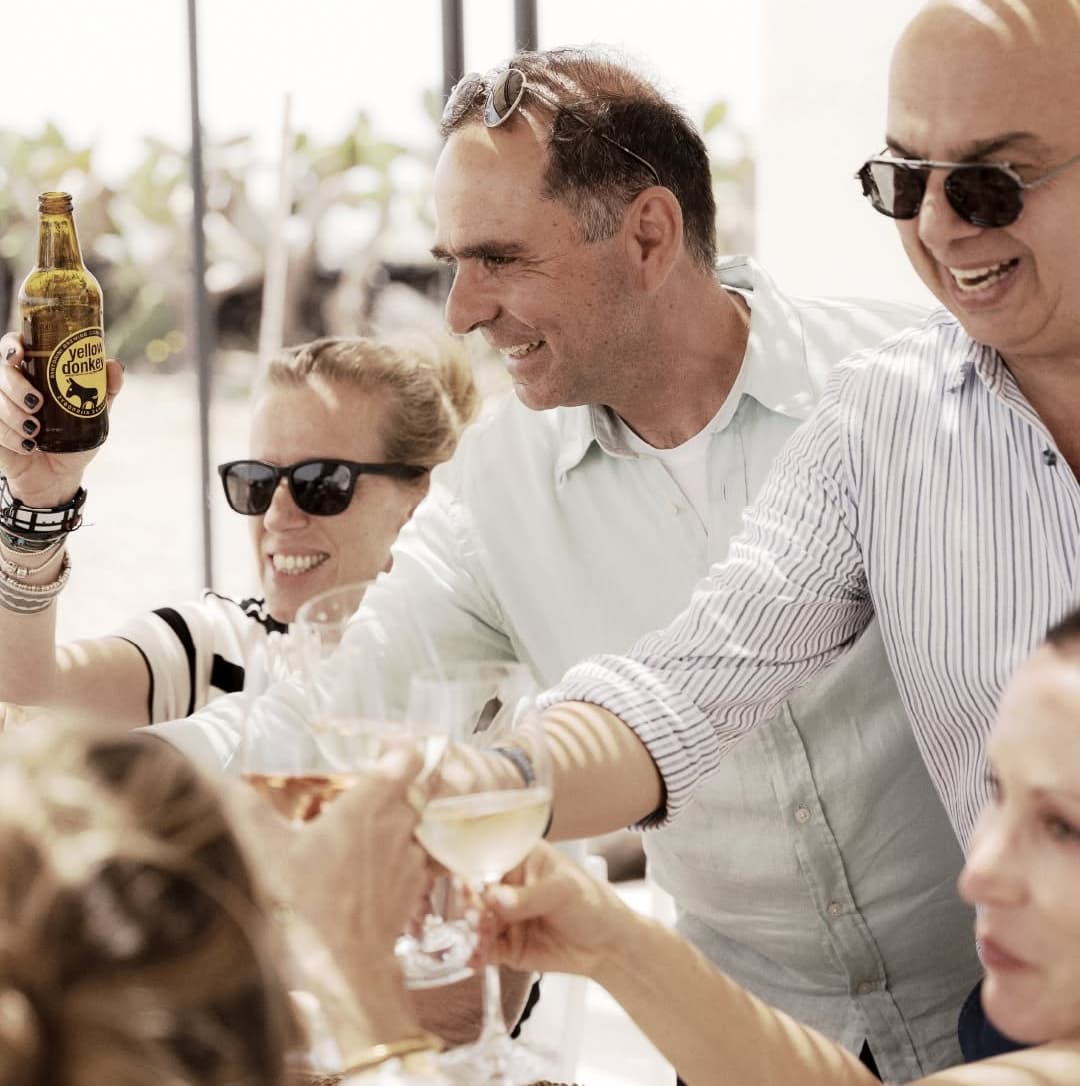
We set down anchor in a secluded bay for a refreshing swim before lunch. The was crystal clear where we could see the seabed through shades of blue and turquoise. Lunch was prepared onboard by the captain using freshly caught fish, grilled over charcoal and finished with lemon and olive oil, alongside Greek salads, local ingredients, and traditional pastries. The skipper kept my glass full with Assyrtiko, kept cool in a bucket of seawater. It remains one of my most cherished experiences.
Mikra Thira Winery Therasia Wine and Volcanic Terroir
Wine becomes the next expression of the island’s landscape, where soil, wind, and salt are translated into something more deliberate. Mikra Thira Winery is the first and only professional winery on Therasia. Founded in 2007 and harvesting its first vintage in 2018, it emerged from a vision of three Greek winemakers: Vangelis Gerovassiliou, Vassilis Tsaktsarlis, and oenologist Ioanna Vamvakouri.

A native of Therasia, Vamvakouri understood what the island's terroir could yield. She encouraged her partners to see the project as an act of cultural preservation rather than commercial opportunity, a commitment to producing wines that reflect what the island's volcanic soils and maritime climate could achieve. They transformed seventeen hectares of rocky, barren terraced land into an organic vineyard.

The winery works primarily with indigenous grape varieties including Assyrtiko, Aidani, and Athiri. Vines are trained in the traditional kouloura, or basket pattern, which protects the fruit from strong winds and harsh sun. Rather than trellises, vines remain low to the ground, woven into basket-like shapes. This approach, used for centuries on Santorini, demands patience and accumulated knowledge.

The resulting wines display minerality, freshness, and salinity that reflect the volcanic soils and maritime environment. The flagship SANTORINI designation carries sharp acidity and structure. The TERRASEA selection, made exclusively from Therasia fruit, is distinct from Santorini counterparts: less aromatic but intensely concentrated, with high natural acidity and a saline mineral finish with aging potential. A guided visit includes vineyard walks, explanations of low-intervention winemaking, and tastings that reveal Therasia's terroir.
Sunsets Over the Santorini Caldera from Santa Irini Retreat Therasia
From Santa Irini Retreat, guests look directly across the caldera toward Santorini. As evening approaches, the cliffs begin to hold light differently, stone and whitewashed surfaces catching a slow shift of colour while the sea moves through tones of blue, orange, magenta, and deep indigo.

What stands out is how undisturbed it feels. There is nothing shaping where you look or how long you stay, just the natural change of light across the caldera. It draws the eye in a steady way, holding attention without effort, and gradually becomes almost mesmerising.

As dusk deepens, Santorini’s lights begin to appear across the water, scattered along the cliff line like a second horizon. Above it, the sky opens fully, with stars appearing closer than expected, unobscured by glare or noise. This is what slow travel looks like, a time to slow down, nowhere to go, just you and your loved one, scarce conversation and silence. Life’s simple pleasures don’t get much better than this.
Why Visit Therasia Greece Santa Irini Retreat Slow Travel Philosophy
Santa Irini Retreat and Therasia represent something increasingly rare: a place where tourism has not become the primary economic driver and therefore has not reshaped the fundamental character of daily life. The island's economy remains rooted in agriculture, fishing, and small-scale viticulture. The people who work at the retreat live on the island rather than arriving seasonally.

What distinguishes the property is not its amenities but the deliberate choice made by its owners to resist the economic logic that drives most luxury hospitality: growth, optimization, and margin expansion. Instead, they asked a different question: what does it look like to create genuine hospitality within a specific community?
The answer requires patience from guests. The menu is not printed because it changes daily based on what is available. The wine tastes like the soil because no one has attempted to make it taste like something else. Time moves differently here, and connection to land and community is straightforward rather than a show.
For those seeking something beyond typical destinations, Therasia offers a practical alternative. It is close enough to Santorini to access easily, yet far removed from the crowds. Arrive in Santorini, transfer to Ammoudi Port, cross by boat in under ten minutes, and within minutes more you arrive at Santa Irini Retreat.

What awaits is an island where life follows practical rather than performative rhythms, where hospitality remains direct, and where landscape, food, wine, and community combine to create something increasingly uncommon. For those who understand that the destination matters less than whether it has resisted the pressure to become something it is not, this is what travel finally becomes.

What you find is an island where landscape, food, wine, and community are still closely connected. For travellers who care less about going to the popular “it” destination and more about going somewhere that feels more real, Therasia and Santa Irini Retreat may be the Greece you’ve been looking for, and thought no longer existed.
Glenn Harris
Glenn Harris is an accomplished journalist focusing on luxury travel, fine dining, and exclusive lifestyle events. His wanderlust has taken him to over 128 countries where he constantly strays off the beaten path to uncover exotic locations, travel gems and exciting experiences to capture.