Dormy House Hotel Review, A Refined Country Retreat In The Cotswolds
A stay in the Cotswolds serves a specific purpose. It is a chance to exhale the smoke, stress, and manic pace of the city creating space in your body to inhale the country and all that it offers. This is a world of fresh air, nature, and narrow country roads tucked between ancient rock walls. It offers life at a slower pace, simpler, easy and a place to leave city life behind for a long weekend or even longer.
The transition from London’s nonstop pace to the bucolic landscapes and country living of the Cotswold happens at the end of a two hour drive. As the motorway narrows into winding lanes flanked by dry-stone walls, the air begins to carry the scent of damp earth and woodsmoke. There you’ll find village of Broadway and the Dormy House Cotswolds. The property has managed to sidestep the stiff formality often associated with English country house hotels, opting instead for comfort over ceremony.
This is a destination for those who are looking for a relaxed style of country living. Dormy House Hotel offers a sophisticated brand of hospitality that feels genuine. There is no grand, intimidating lobby here. Instead, guests are welcomed into a space that feels like the home of a well-traveled friend.
A Story Shaped by Centuries
Dormy House occupies a former farmhouse site above the village of Broadway, its story shaped by several distinct chapters that remain legible today. The building dates back to the seventeenth century, when it was known as Willersey Hill Farm, before evolving into a private residence and later taking on a more public role in the mid twentieth century. For nearly fifty years it served as the clubhouse for the neighbouring Broadway Golf Club, a period that gave the property its name, drawn from the golfing term used when a player leads by as many holes as remain to be played. That era established the house as a place of gathering, outlook, and hospitality long before it became a hotel.
Over time the house transitioned fully into hospitality, with each phase of change handled with restraint. Stone walls, exposed beams, and the original proportions of the building have been carefully preserved, allowing the structure to retain a sense of continuity rather than reinvention. The result is a property that feels shaped by use rather than redesigned for effect.
Today Dormy House sits within the 500 acre Farncombe Estate, a broad expanse of woodland and pasture that has been in the care of the Sorensen family since 1977. Under the Farncombe umbrella, which also includes Foxhill Manor and The Fish Hotel nearby, Dormy House forms part of a collection that approaches hospitality as an extension of landscape and heritage.
Location and the Vernacular Landscape
Dormy House stands above Broadway in Worcestershire, overlooking one of the most recognisable corners of the Cotswolds. The landscape here rolls in long, measured lines, fields divided by stone walls. From the estate, views stretch toward the escarpment and the folds of countryside that continue far beyond the village.
The grounds are generous with terraces step away from the main building toward lawns, where borders of perennials mark the change of season. A kitchen garden produces herbs, leaves, and vegetables used across the menus. Walks begin almost at the doorstep. Some stretch gently across farmland, others follow rising ground toward broad viewpoints. They are working countryside paths rather than manicured hotel trails, shared with livestock.
Architecture and Interior Character
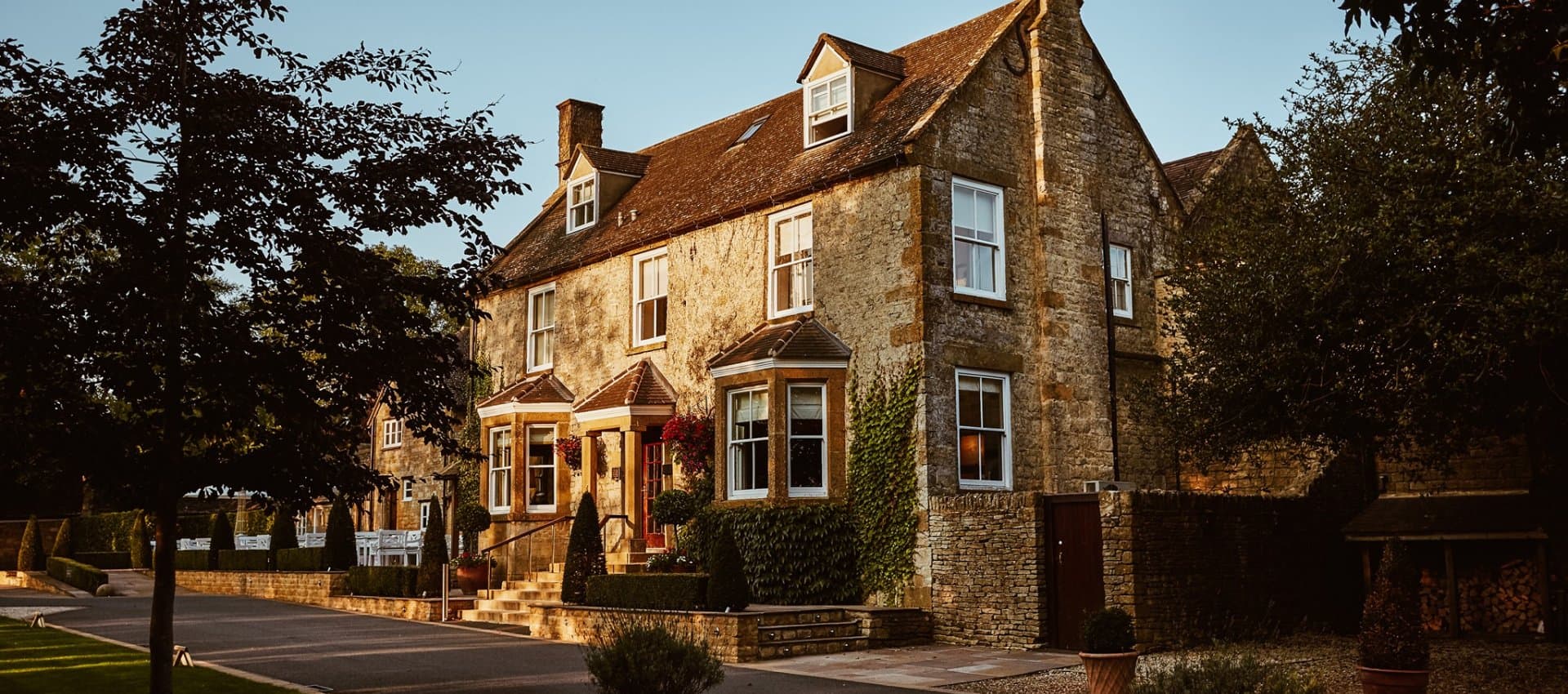
From outside, Dormy House offers a façade of layered roofs, chimneys, and stonework that reflects the vernacular of the region. The ochre colored limestone exterior is accented with windows that sit deep in the walls, giving the building a sense of substance and age. It looks like a house that has grown organically over time rather than an architectural statement imposed on the land. Extensions sit in conversation with earlier structures. Wings reach toward gardens and terraces in a way that feels natural, like chapters added to a story rather than rewrites of it.
Inside, the design language is warm, tactile, and functional with oak tables and woven rugs and inspiring artwork. The drawing rooms and lounges are arranged in clusters that encourage conversation or quiet reading, giving guests space to occupy a room rather than merely pass through it. Fireplaces are central to the atmosphere, especially in winter when they gather the room into gentle pockets of heat and amber light. Tall windows open views across lawns and fields, and natural light plays a constant role in shaping mood throughout the day.

The Sanctuary of Rooms and Suites
Bedrooms continue this sense of grounded comfort. Some feature exposed stone or timber beams, others lean toward softer textures and contemporary country design. Beds are substantial and supportive, with linen that feels purposeful rather than decorative. Lighting is layered and soft, designed for reading, resting, or sitting awake late after a long day outside.
Bathrooms are generously proportioned, with deep tubs and strong showers. Certain rooms include fireplaces, which transform the space entirely on cold evenings. Views vary across the estate, but there is always a sense of connection to the surrounding land, whether through a distant horizon line or the movement of trees in the wind.
Culinary Heritage: From The Shed to The Back Garden
The Shed is a timber-beamed room which functions as the primary social hub of the hotel. Its name pays tribute to the property’s origins as a 17th-century working farmhouse, with an interior defined by nostalgia and grit. The decor features antique farm tools and historical images of the estate’s past, anchored by a large, weathered plow mounted on the wall as a central feature. Designed more as a communal lounge than a standard bar, the space is defined by its central circular bar and a prominent fireplace that anchors the room. The kitchen serves rustic British meals that emphasize comfort and seasonal produce.
Dining at Dormy House centres on The Back Garden, the hotel’s principal restaurant and the clearest expression of its food philosophy. The approach is described as Best of British, but the execution is grounded rather than declarative. The kitchen works closely with local farmers and producers, sourcing high welfare rare breed meats, responsibly grown grains, and vegetables that reflect the agricultural character of the surrounding Cotswolds. Much of what appears on the plate is shaped by what is grown close by, including herbs and produce from the hotel’s own garden. Menus evolve with the seasons in a way that feels practical and attentive rather than performative.
Precision Dining and the Wellness Retreat
MO offers a more focused expression of the kitchen’s approach, shifting from relaxed country dining to precision and technique. Open from Thursday to Sunday evenings, this chef’s table style restaurant seats just twelve guests, all dining together at a single sitting. The eight course tasting menu is shaped by local, seasonal ingredients, with sustainability guiding both sourcing and structure. Unexpected combinations, refined plating, and moments of technical precision provide interest without overshadowing substance.
The spa sits slightly apart from the main house, a self-contained environment where stone, water, and light define the mood. The pool room reflects daylight across its surface, creating a calm visual rhythm as you swim. Therapy rooms feel cocooned and private, with treatments that draw on botanical infusions and contemporary techniques without drifting into excess. Outdoor hot tubs and thermal areas offer places to sit and absorb the air and temperature of the season. Time in the spa feels restorative not because it withdraws you from the estate, but because it frames it from a different perspective.
Exploring the Cotswold Landscape
Walking remains one of the most rewarding ways to connect with the landscape around Dormy House. Paths leave directly from the estate, climbing gently toward the escarpment before flattening into open farmland. Broadway acts as a practical starting point for exploring further afield. Its broad high street supports independent shops, galleries, and cafés that serve daily life as much as passing visitors. From here, short drives lead into a wider constellation of Cotswold villages, each distinct in scale and character.
Dormy House does not rely on spectacle or performance to define its identity. It draws strength instead from attention to detail, from the integrity of its setting, and from the consistency with which it treats both guests and place. Time there is measured through texture, weather, light, and meals shaped by what is grown and sourced nearby. It offers the experience of staying in a country house that has evolved with care rather than been reinvented for effect. In a region known for postcard-ready imagery, Dormy House Hotel and Spa feels grounded and real, a hotel that remains closely connected to the landscape and community that surrounds it.
The quiet sophistication of Dormy House provides a rare equilibrium between high-end luxury and the unpretentious warmth of a rural retreat. By grounding every aspect of the guest experience in the authentic rhythms of the Farncombe Estate, the hotel offers more than just a place to sleep; it offers a profound sense of belonging. Whether through the tactile comfort of its hearths or the seasonal honesty of its kitchens, a stay here serves as a lasting anchor to the enduring character of the Cotswolds.

Glenn Harris
Glenn Harris is an accomplished journalist focusing on luxury travel, fine dining, and exclusive lifestyle events. His wanderlust has taken him to over 128 countries where he constantly strays off the beaten path to uncover exotic locations, travel gems and exciting experiences to capture.